
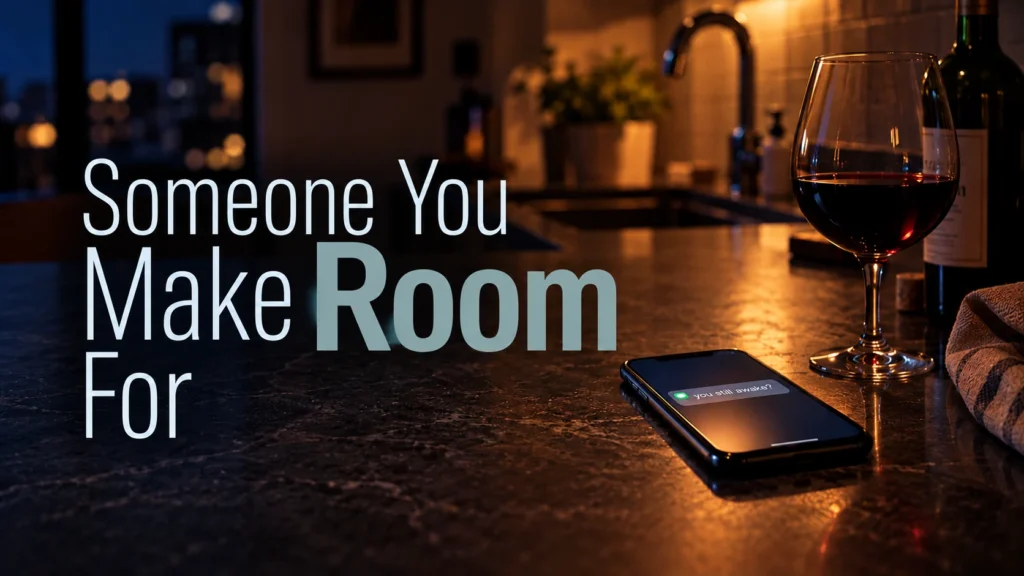
1
At twenty to eleven on a Thursday, Martin was in the bathroom, toothbrush in his mouth, when his phone lit up on the back of the toilet.
you still awake?
He knew what it meant. Owen’s evening had gone wrong somewhere, or the person he’d spent it with had gone home, or he’d had four drinks and the idea of his own apartment had turned unbearable. It was a particular message, sent at a particular hour. Martin had received it perhaps forty times in five years.
He spat, wiped his mouth, and typed: Depends what you’ve done.
nothing criminal yet
You’re always ten minutes away.
I’m very consistent
Martin put the kettle on. He didn’t ask whether Owen wanted tea because he already knew, and he didn’t stop to think about how he knew.
Owen arrived in a coat that smelled of someone else’s kitchen, holding a bottle of wine by the neck like something he’d rescued.
“That’s from someone’s table,” Martin said.
“Barry’s. He doesn’t drink red.” Owen was already past him, into the hall. “It’d only have gone to waste.”
He was funny for twenty minutes. He told a story about Barry, who had cried in an elevator, and he ate most of the bread, and then, mid-sentence, he stopped and looked up.
“Is that your faucet?”
“It’s been doing that for a month.”
“You told me that. On the phone. You said the faucet was winning.”
“I don’t remember saying that.”
“One of us does.” He was on his feet. He went out to the car, came back with a canvas bag, and lay down on Martin’s kitchen floor with his head under the sink, humming something Martin half-recognized. Eleven minutes later he stood up with a wet forearm.
“New washer. Your pipe’s loose, which is the actual problem, but the washer will hold.”
Martin stood in the doorway holding two cups of tea.
The rest was easy, as always. The talking slowed, and then stopped, and they went to bed the way they had maybe a dozen times in five years: unhurried, familiar, neither of them saying anything afterward that needed saying. Owen was warm and heavy and entirely present. Whatever this was, he did it well.
By seven thirty, he was gone. Martin washed a cup, turned off the faucet, and listened to it not drip. He stood there a moment, absurdly taken care of, and went to work.
2
On Monday, Martin texted.
Ruth and Paul are coming over Saturday. Nothing fancy. Come and eat something.
Can’t, Owen said. Friend’s birthday thing
No worries.
The next week, Martin tried again and got specific, in case that was the problem.
Saturday? That Turkish place, then a movie. Or a walk, if you’d rather. Two o’clock.
Yeah, maybe let’s see how the week goes
Martin looked at that for a while. He was not a man who sat by a phone. He had been divorced eleven years and had liked living alone for nine of them. He had Ruth and Paul, who were married and whom he saw most weeks. He had a book group that read about a third of the books. He swam on Wednesdays. He had a niece in Chicago who called him when she was worried about her mother. He had a life, and he wanted that on the record in case anybody asked.
He had only noticed, at last, that Owen never made a plan with him more than two days out. He came after the dinner that had ended early. After the weekend that had fallen through. On Thursday nights, at twenty to eleven, when there was nowhere better to be.
On Wednesday, he typed Thursday, then deleted it. He didn’t want to be the kind of man who sent a message to prove something.
Owen wrote in lowercase and never used a period, so that every message felt like it might still be going on. Martin had always found this charming. He still found it charming. For the first time, he noticed that it also meant nothing was ever finished.
Martin, being fair, considered whether it was his own fault, decided it probably was, and thought about something else until Thursday.
3
The restaurant was a Lebanese place downtown that Ruth and Paul liked because the owner knew them. Martin was halfway through a plate of something with too much garlic in it when Owen came in with seven other people.
Owen saw him first. He crossed the room at a speed that was genuinely flattering and put a hand on Martin’s shoulder.
“You. Hello. What are you doing here?”
“Eating.”
“This is Martin,” Owen said to the table behind him, in a voice that carried. “Funniest man in the city. Ask him about Barry.”
Two of them laughed and waved. Owen pulled a chair over and sat for four minutes, just long enough to be warm and charming, then remembered he had a table.
“Are you all –” Martin began.
“The Berkshires. Weekend after next. Barn. Marcus knows a guy.” Owen rolled his eyes at himself. “Eight of us. Very grown-up. There’s a wood stove and everything.”
“You organized it.”
“Worse. I booked it. I made a sheet.” He said this with the particular pride of a man who is usually disorganized and has just discovered a talent. “It’s been on the calendar since June.”
June. Martin did the math while Owen kept talking. They had spent a Thursday night together in June. Another in August, when it was too hot to sleep and neither of them had suggested leaving.
He hoped the wood stove smoked.
“Anyway.” Owen stood. “Let’s get together next week, yeah?”
“Yeah.”
Back at the table, Ruth watched him sit down.
“He’s lovely,” she said.
“He is.”
“How long have you two been…” She let the sentence end where it liked.
“We’re not anything,” Martin said. “That’s the arrangement.”
Ruth gave him a look he chose not to accept.
He walked home, and somewhere between the restaurant and his front door he understood it properly, like something you’ve known for a year.
Nobody had done anything wrong. That was the worst of it. Owen liked him. Owen had crossed a room to put a hand on his shoulder. Owen had fixed his faucet in eleven minutes because he’d remembered one sentence from a phone call Martin had forgotten.
And Owen had booked a barn in the Berkshires in June for eight people without once making room for a ninth.
Martin had answered every message. He had never once said no, or not like that, or that he’d actually made a plan. He had been so careful not to press that he had taught Owen the exact shape of him: a man with no calendar, a man who could be reached, a man who was always awake.
He had helped.
4
Owen turned up the following Tuesday, uninvited but not unwelcome, with two beers and a bag of chips, and within ten minutes had asked Martin twice what was wrong.
“Nothing.”
“You’re doing the thing where you’re fine.”
“I’m fine.”
“See,” said Owen. “That’s the thing.”
They sat. Owen talked about the barn, the sheet, and Marcus’s brother-in-law, who was coming and who everybody was worried about. He was funny about it. Then he stopped and looked at Martin properly.
“Okay. Out with it.”
Martin took a breath and asked before he could put it in nicer terms.
“Do you ever actually make plans to see me? Or do I just happen to be available?”
Owen’s face did something complicated: surprise, and then, quickly, the beginning of a defense.
“I’m here.”
“You’re here because you were bored at eight o’clock.”
“I was bored at eight o’clock, and I thought of you. That isn’t nothing.”
“No. It isn’t nothing.”
Owen put his beer down. “You’ve never pushed for anything. You’ve never once said, Owen, Wednesday, be there. You ask, I say maybe, you say no worries, and then it’s Thursday, and I’m driving to your place. You can say no. You’ve always been free to say no.”
“I know.” Martin turned the bottle in his hands. “That’s not the same as being asked.”
Owen opened his mouth, closed it, and looked at the wall behind Martin’s head.
“Fine,” he said. “All right. What do you want?”
That was the question Martin had avoided for five years, mostly because the honest answer was so unglamorous.
“I don’t want more of you,” he said. “I want…” He stopped because the sentence had no tidy end.
“Want what?”
“I don’t know. To be on the list.” He heard how it sounded. “If I wanted to sleep with you, that’d be simple.”
“You do sleep with me.”
“Yes. That part’s easy.”
Owen sat with that. He wasn’t defensive anymore; he had the look of a man doing math in his head and not liking the total.
“You’re not a backup,” he said. “There’s no ranking.”
“I know,” said Martin. “It’d be easier if there were.”
Owen looked at him for a second, then, because he wasn’t a man who could leave silence alone, filled it.
“I thought we were the good thing,” he said. “The one that doesn’t need managing.”
“You manage everything else.”
“Exactly.”
“Yes,” said Martin. “Exactly.”
Neither of them said anything for a while, which was not unpleasant.
“Right,” Owen said eventually. “Saturday. A real Saturday. I’ll book something.”
“All right.”
He left at eleven thirty, not staying the night, and patted the doorframe as he went, the way he always did.
Martin sat in the kitchen a while longer. It was the most Owen had ever said about the two of them, and every word was true. The Saturday, when it came, would be lovely.
He was not angry. He had simply stopped being confused, and confusion, it turned out, had been doing most of the work.
5
The Saturday happened. Owen booked the Turkish place Martin had suggested weeks ago. He got there first, which he had never done before, and made a small production of it. They ate too much and laughed until Martin had to put his fork down. Halfway through, Owen said, “Did the faucet hold?” Martin said it had. Owen said, “Good,” and went back to the bread.
By any measure, it was one of the better evenings of Martin’s year. Nothing about it changed anything.
Two weeks later, on a Thursday, at twenty to eleven, his phone lit up.
you around?
Martin was in the kitchen in a sweater with a hole in the elbow, a glass of wine on the counter, something on the television he’d stopped watching twenty minutes ago. Nothing important. Nothing that would be lost.
He read the message twice. The affection was all still there, and so was the other thing, and he knew, with a certainty that felt almost dull, like weather, that an evening with Owen would be good. It always was.
He typed: Staying in tonight.
no worries, another time
Martin put the phone down, stood with his hand on the counter, and felt it arrive in two pieces. First the disappointment: how easily Owen had accepted it. Not a flicker, not an “oh, come on, not again,” as if Martin’s absence cost nothing.
And then, behind it, something like relief. He had stayed in, on a Thursday, like a man with a life.
At twenty past eleven, he opened the thread again, got as far as “Actually,” and didn’t send it.
He rinsed his glass and set it upside down on the rack. He turned off the faucet; it didn’t drip, and he went to bed, missing him.